Security Center

Keep your accounts and data safe.

MECU's New Fraud Alert Number is 494-47

Need a different number? Take a look at our MECU Visa Cardholder Reference Guide.

Stay in the know. Stay in control.

MECU will never tell you ...

To withdraw money from an ATM to send somewhere else.

MECU will never contact you by ...

Phone, email, or text message to ask for your account number, personal identification number (PIN), social security number or any personal information. When you call us directly, we will only ask you to provide this information to verify your identity.

MECU will never tell you ...

To send money to us via CashApp, Zelle®, or any payment solution.

How do identity thieves operate?

Check Fraud

Check fraud is when an unauthorized person uses someone else’s checks, or images of a check, to make unauthorized purchases or withdrawals.

Different types of check fraud include:

  • Check fraud: Scammers steal, or forge checks to make unauthorized transactions.
  • Check washing: Legitimate checks are altered or “washed” with chemicals to erase the ink from a check to rewrite amounts and payees.
  • Check cooking: Fake checks are digitally created to look legitimate.
  • Mail fraud: Fraudulent checks are sent or received through the mail.
  • Endorsement forgery: A signature is forged to cash a victim's check. 

Pretexting

Scammers pretend to be legitimate businesses or government agencies when they contact financial institutions or other organizations to get your financial information.

Skimming

Skimmers insert illegal electronic devices into ATMs or electronic payment terminals in order to steal debit and credit card numbers.

Spoofing

Identity spoofing occurs when a scammer assumes the identity of another person/entity and uses that identity to commit fraud. Spoofers steal credentials from people or businesses through password attacks and credential capture processes.

Dumpster Diving

Lawbreakers rummage through trash, looking for bills or other papers with personal and financial information.

Changing Your Address

People divert your billing statements to another location by completing a U.S. Postal Service change-of-address form.

Old-Fashioned Stealing

Criminals steal wallets and purses; mail, including bank and credit card statements; pre-approved credit offers; and new checks or tax information. They also take personnel records or bribe employees who have access.

Phishing

Phishers pretend to be financial institutions or legitimate companies and send spam emails or pop-up messages to get you to reveal your personal information.

Quishing

Quishing, also known as QR code phishing, involves tricking someone into scanning a QR code using a mobile phone. The QR code then takes the user to a fraudulent website that might download malware or ask for sensitive information.

Spyware

Criminals can install stealth software on your computer that lets them steal your identity and do other damage. (Learn what spyware is, how to tell if it's on your computer, get rid of it, and avoid it altogether.)

Malware

Criminals sometimes use malware – including viruses – to get into your computer, steal information, send spam, and commit fraud. (Learn the signs of malware and how to get rid of it.)

SIM Swapping

Scammers trick mobile carriers into transferring a victim’s phone number to a new SIM card, gaining access to sensitive accounts like banking apps. This can lead to unauthorized transactions and identity theft

Tip for Members: Protect your accounts with multi-factor authentication (MFA) and avoid sharing personal information on social media that could be used to answer security question.

Buy Now, Pay Later (BNPL) Scams

With the popularity of BNPL services, scammers are setting up fake online stores that appear to accept BNPL payments. Victims make purchases and later find out the store was fake, losing their money.

Tip for Members: Verify the legitimacy of online stores before making a purchase, especially if they offer BNPL options. Look for reviews and confirm the store’s contact information and policies.

Gift Card Scam

A fraudulent individual instructs you to purchase a gift card, such as a Google PlayTM or Apple® Gift Card, and provide them with the card's numbers from the back. Regardless of their claims, this is a scam. Legitimate businesses or government agencies will never ask you to use a gift card for payment. If you suspect you've fallen victim to such a scam, even if it occurred some time ago, it's crucial to report it to the respective gift card company.

DOGE Scam

Law enforcement agencies are warning about a new scam where individuals receive a text claiming they are eligible for a $5,000 government subsidy from the Department of Government Efficiency (DOGE).

The message instructs recipients to reply with "Y" and click a link labeled "Tech Radar" to receive their payment. It promises that after providing personal information, a check will be deposited into their bank account or mailed within one to two business days.

There are currently no DOGE refunds, dividends, stimulus, or other payments.

Grandparents Scams

You might receive a call or text from an individual posing as a grandchild or dear one, urgently requesting financial assistance for an emergency. These scammers manipulate caller ID information to make the call seem like it's coming from a trusted contact. Furthermore, these fraudsters leverage artificial intelligence technology to replicate the voices of loved ones, aiming to deceive you into believing they are genuinely in need of help.

Business Email Compromise Scam

You get an email purportedly from a vendor, asking you to transfer funds to a different account. Although the email appears authentic, it may be a deceptive communication from a fraudster who has gained unauthorized access to your vendor's network.

MECU Impersonation

If someone from MECU or another financial institution reaches out to you concerning alleged fraudulent activity on your account and requests a money transfer or payment redirection, exercise caution. If uncertain, end all communication with the potential scammer and contact the phone number provided on the back of your debit or credit card for verification.

Fake Job Scams on Professional Networks

Scammers are posting fake job openings on professional networks, luring job seekers into paying upfront for fake fees like background checks or training.

Tip for Members: Be cautious of job offers that require upfront payments. Research the company and the job posting, and avoid sharing personal information until you have confirmed the legitimacy of the job offer.

Where should you report fraud?

Phone Numbers to Report Fraud
Domestic Calls
International Calls
MECU Visa® Debit Card or Credit Card 866-820-1039 866-820-1039
Lost/Stolen MECU Visa® Debit Card or Credit Card 866-820-1039 866-820-1039
Identity Theft and Other Fraud 866-820-2958 Not Applicable
MECU Visa® Credit Card Balance Transfers 866-820-3867 Not Applicable

How to protect yourself against fraud.

Know the Common Fraud Threats

Research common threats to help yourself stay alert to potential threats.

Set Safe Passwords

Change your password frequently and use a combination of upper and lower case letters and numbers.

Monitor Your Accounts & Credit

Regularly check on your accounts and confirm any charges that have been made.

Report Account Fraud or Scam

Report fraud as soon as it happens.

What number does MECU use to send SMS fraud alerts?
  • MECU SMS Fraud Alerts are free and will come from 494-47. Please save this number in your contacts with a name you will recognize for future alerts.
  • We recommend "MECU Fraud Alerts." The fraud alert messages sent from this number will also be labeled with MECU's name.
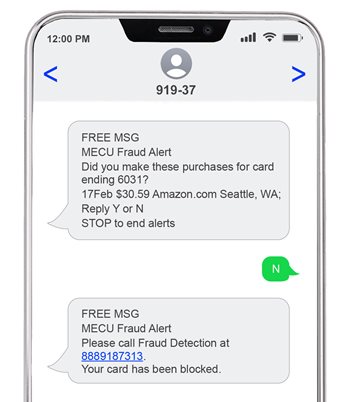
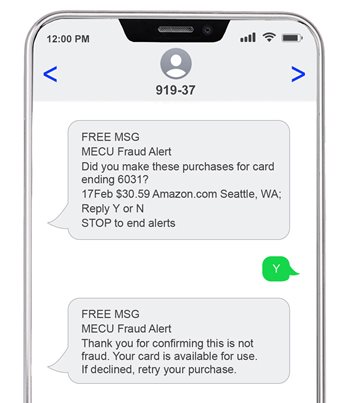
SMS response options
  • A "Yes" response confirms the purchase(s) and no further action is required.
  • A "No" response denies the purchase(s). Your card will be blocked until you call Fraud Detection.
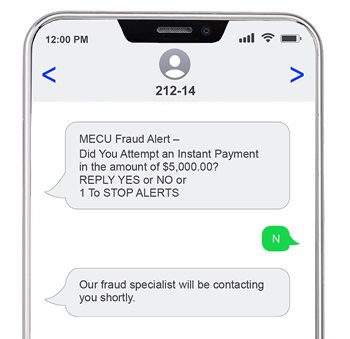
Don’t become a victim of "Reverse Instant Payments" scam

Cybercriminals are targeting victims by sending text messages with what appear to be credit union fraud alerts asking if the customer initiated an instant money transfer using digital payment applications (apps). Once the victim responds to the alert, the cybercriminal then calls from a number which appears to match the financial institution's legitimate 1-800 support number. Under the pretext of reversing the fake money transfer, victims are swindled into sending payment to bank accounts under the control of the cyber actors. The payment amount and financial institution name changes from victim to victim. If the customer replies "No," a follow-up message is sent.

The scam shown is a SMS message made to imitate MECU Credit Union. Please, remain vigilant and do not fall victim to cybercriminals.

Remember, MECU SMS Fraud Alerts come from 494-47.

Technology is the favorite tool of many identity thieves.

Nearly nine million Americans have their identity stolen each year. It pays to educate yourself on how these crimes occur so you can take steps to prevent them.

Keep these tips in mind:

  • MECU or any reputable financial institution will never request peer-to-peer payments to address fraud activity.
  • Refrain from sending money to individuals claiming your account is compromised or threatening service termination.
  • Report any suspicious activity immediately.
  • If uncertain, conclude the call and contact MECU through authentic channels using the numbers on the back of your debit or credit cards.
  • Avoid using search engines to reach the MECU website; instead, use mecu.com or the MECU Mobile app for account access.
If you've fallen victim to identity theft, you're not alone!

Recovering your identity after it's been stolen can be an overwhelming process, but we're here for you. Your first step is to call us at 866-820-2958. Here you will begin the process of reporting and developing a recovering plan.


Frequently Asked Questions

Need more guidance?